How Much Does a Maine Coon Cost: What Determines a Kitten's Price
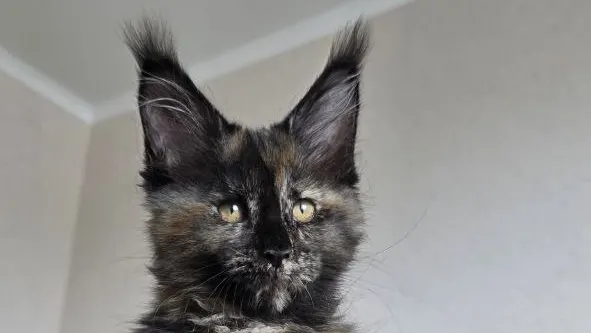
"How much does a Maine Coon cost" is the first question almost every prospective owner asks. The answer "from 30 to 350 thousand rubles" doesn't explain much, so let's be transparent: what exactly you're paying for and why kittens that look similar can have different prices.
How Much Does a Maine Coon Kitten Cost in 2026
The actual price range in Russian catteries is as follows:
- 15 000 – 40 000 ₽ — a kitten without documents, from an unregistered breeder or private seller, often a mixed breed. The breed cannot be guaranteed here.
- 60 000 – 150 000 ₽ — pet-class: a purebred kitten with a pedigree, intended for a home, without breeding rights.
- 150 000 – 350 000 ₽ — breed-class: a promising animal for breeding work.
- от 350 000 ₽ — show-class: a kitten with show potential, usually from a titled lineage.
You can find our current prices, along with the kitten's class, in the Kittens section. Some kittens are offered in two options: as a cherished pet (with mandatory neutering/spaying) and for breeding — prices differ in these cases.
Why the "Private Sale" Price is So Tempting
The difference between 25,000 and 120,000 ₽ is not due to breeder greed. It covers DNA tests for HCM, SMA, PKD, and PKDef in both parents, annual heart ultrasounds, breedings with proven sires/dams, high-quality food for the pregnant queen, vaccinations, microchipping, documentation, and veterinary care for the litter. A kitten without all these measures is cheaper precisely because no one is accountable for its health and wellbeing.
What Determines the Price
1. Animal Class
Pet, breed, and show categories do not refer to a "cat's quality," but rather its intended purpose. A pet-class kitten can sometimes be more beautiful than a show-class one; it might simply have, for example, an unconventional bite or a white spot in an undesirable location. While these aspects don't matter for a family pet, they are critical for the show ring.
2. Documentation
A WCF or FIFe pedigree costs money and requires the cattery to maintain club membership, register litters, and pay for each document. A kitten's metric certificate is exchanged for a pedigree — this confirms that you are acquiring a genuine Maine Coon, not just a "large cat that looks similar."
3. Parents' Health Tests
DNA tests for Hypertrophic Cardiomyopathy (HCM), Spinal Muscular Atrophy (SMA), Polycystic Kidney Disease (PKD), and Pyruvate Kinase Deficiency (PKDef), along with regular echocardiograms, represent the most significant expense for a responsible cattery. We have written more about these diseases in our article on Maine Coon health and lifespan.
4. Parents' Titles and Lineage
Kittens from Champion, Grand Champion, and World Champion titled parents are more expensive: their lineage represents years of selective breeding and significant show expenses. You can view the pedigrees of our breeding cats in the Males and Females sections.
5. Coat Color and Special Features
Rare coat colors — silver, smoke, black solid, blue — are typically more expensive than classic tabby. Polydactyls (cats with extra toes) and kittens with prominent ear tufts are also particularly valued. What the letters in a color code mean is explained in our guide to coat colors.
6. Age
A kitten leaves for its new home no earlier than 3–3.5 months of age: by this time, it is fully vaccinated, litter-trained, scratch-post trained, and well-socialized. Older kittens (5–8 months) are sometimes less expensive — simply because they have waited longer for their forever family.
What's Included in Our Price
- Kitten's metric certificate, exchangeable for a WCF pedigree;
- Veterinary passport with vaccination and treatment records;
- Microchipping;
- Purchase agreement;
- Starter food and training for litter box and scratch post;
- Lifelong breeder support and consultations.
Hidden Costs: What It Takes to Maintain a Maine Coon
The Maine Coon is a large cat, and its upkeep is more expensive than that of an average domestic cat. An approximate monthly budget includes:
- Premium-class food — 4,000 – 7,000 ₽ (an adult cat eats 1.5–2 times more than an average cat);
- Litter — 1,000 – 2,000 ₽ (an XL-sized litter box is required);
- Veterinary care — from 10,000 ₽ per year for routine vaccinations and check-ups.
One-time initial expenses — carrier, bed, a scratch post at least 1.2 meters tall, bowls, brushes — are thoroughly discussed in our article What to Buy for Your Maine Coon Kitten.
How to Avoid Overpaying and Buying into Problems
- Ask to see parents' health tests — not just "words," but a photo or scan of the results with the animal's name.
- Observe where the kittens live: a video call from the cattery home can tell you more than ten photographs.
- Ensure the breeder asks you questions. A breeder who doesn't care where the kitten goes often doesn't care how it was raised either.
- Be wary if a kitten is offered at 1.5–2 months: it should remain with its mother until at least 3 months of age.
- A price that is too low is not a stroke of luck, but a red flag. Treating just one illness in a large cat can cost more than the price difference.
If you have any further questions, please contact us: we will tell you honestly about each kitten, including details not visible in photographs.