Maine Coon Size and Weight: Monthly Chart and the Truth About 'The Biggest Cats'
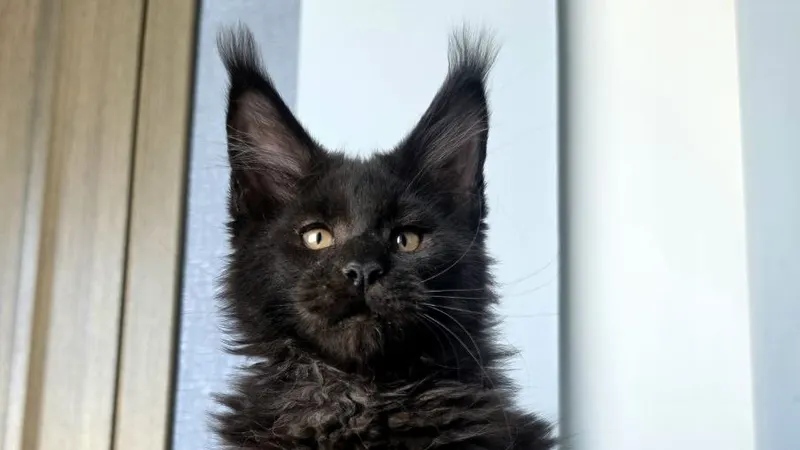
The Maine Coon is the largest breed of domestic cat, and it's often their impressive size that makes people fall in love with them at first sight. Let's delve into which figures are realistic and which are the result of clever angles and wide-angle lenses.
How Much Does an Adult Maine Coon Weigh?
- Males — 7–10 kg, larger specimens up to 12 kg.
- Females — 4.5–7 kg.
- Body length with tail — 100–120 cm for males, 80–100 cm for females.
- Height at withers — up to 40–45 cm.
Anything heavier than 12–13 kg is either obesity or an exaggeration. A healthy Maine Coon is a long, muscular, and heavy cat, not a fat one.
Kitten Weight Chart by Month
Approximate values; a deviation of 10–15% is normal, as kittens grow unevenly.
- 1 month — 550–740 g (females), 630–820 g (males)
- 2 months — 1.1–1.5 kg / 1.2–1.8 kg
- 3 months — 1.7–2.3 kg / 2.0–2.5 kg
- 4 months — 2.7–3.6 kg / 3.0–3.8 kg
- 6 months — 3.2–4.0 kg / 3.8–5.5 kg
- 9 months — 4.0–5.5 kg / 5.0–7.0 kg
- 12 months — 4.5–6.0 kg / 5.7–9.0 kg
Each of our kittens has a growth diary on their page with weekly photos and weights — you can see how a specific little one has changed: view kittens.
Until What Age Does a Maine Coon Grow?
Unlike most cats, the Maine Coon develops until 3–4 years of age. At one year old, they are still adolescents: their length continues to increase, their chest widens, and their “cheeks” and mane appear later. Therefore, it's too early to assess an adult size based on a one-year-old cat.
The Biggest Maine Coon in the World
The record holder was long considered to be the cat Stewie (Mymains Stewart Gilligan) — 123 cm from nose to tail tip. Later, the record passed to the cat Barivel from Italy — 120 cm. Please note: records are set based on length, not weight — it is length, not mass, that distinguishes the breed.
Photos of "dog-sized Maine Coons" from social media are almost always taken with an outstretched arm: the cat near the lens appears twice as large. A good benchmark is a photo of the cat next to a person standing upright, rather than being held in arms.
What Determines the Final Size?
Genetics
The main factor is the parents and the bloodline. Large breeding cats produce large offspring, which is why you can always see the kitten's mother and father at our cattery: Males, Females.
Nutrition
A Maine Coon needs food with a high protein content and the right balance of calcium and phosphorus. Overfeeding won't make the cat bigger — it will make them heavier, and excess weight in a large cat puts strain on their joints.
Neutering/Spaying
A common myth is: "a neutered cat will grow smaller." In reality, early neutering/spaying often results in a longer cat, as growth plates close later. Nutrition has a far greater impact on weight and health.
A Big Cat — Big Requirements
Size affects daily life more than it seems:
- Litter box — at least 60 cm long, preferably 70 cm;
- Scratching post and complex — stable, with platforms designed for 8–10 kg;
- Carrier — size L/XL, a standard cat carrier will be too small by 8 months;
- Bowls — wide and on a stand, so the cat doesn't have to stoop.
For detailed information on what to buy, please refer to the article What to Buy for a Maine Coon Kitten, and for care of their magnificent coat, see the article Coat Care.